Fiefs Vendéens: Loire Valley Wines of Quality & Value

•October 3, 2010 • Leave a Comment

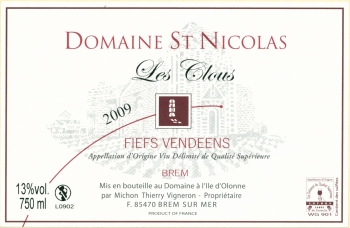
We were plowing through the agenda at a sales meeting a couple of days ago when one of my associates offered to share some wines that he was presenting to a customer later in the day. They were from Fiefs Vendéens, a small AOVDQS in France’s Loire Valley south of Nantes, the production area famous for Muscadet.

I have always been a big fan of the wines of the Loire Valley. The variety, quality and value are incredible. You’ll find delicious whites, reds, rosés, sparklers, sweet, dry—they’re all produced there. And although many common grapes are used in this region (sauvignon blanc, pinot noir, chardonnay, etc.), several other less common ones are also well employed, including some of my favorites: chenin blanc, cabernet franc and melon de bourgogne.

The Fiefs Vendéens appellation was created in 1984 and comprises four sub-zones named after their respective villages: Brem, Mareuil, Pissotte and Vix. The main grapes are chenin blanc, sauvignon blanc, chardonnay, gamay and pinot noir. The maritime climate (the Atlantic Ocean is nearby) helps keep the wines well-structured (nice acidity), with restrained alcohol, and subtle fruit.

The wines we tasted were from a biodynamic producer in Brem named Domaine Saint-Nicolas. The soil there is made up primarily of schist and silex, as opposed to the clay and silex found in the other three villages. Saint Nicolas is one of the few producers in the area to age their wines in oak barrels and the wines are clean, well-structured and reasonably priced (most should retail for less than $20). The proprietor is a passionate gentlemen named Thierry Michon, who is a tireless advocate for Fiefs Vendeens and biodynamic farming. His wines are imported in the United States by Jon-David Headrick Selections, a specialist in small production Loire Valley wines. (Disclosure: I proudly sell these wines in California.)

Favorite Wine Anecdotes – Overdoing it with Wine Descriptors

•September 20, 2010 • Leave a Comment

If you want to take the allure out of wine, just put more effort into describing it than simply enjoying it. I was recently at a wine bar and the woman next to me ordered a glass of sauvignon blanc from the Marlborough region of New Zealand. The server thoroughly described the bouquet and flavor of the wine as he poured her a glass. I thought he overplayed it a bit with the lengthy description, so I offered that sometimes a hint of cat pee is also present on the nose of sauvignon blanc from that particular region, and also in France’s Loire Valley sauvignon blancs of Sancerre and Pouilly-Fumé. She laughed and probably thought I was playfully commenting on the over-the-top explanation of her wine. Unfortunately (or not), there wasn’t any cat pee to be found on the nose of her glass of vino, she still refused to believe me, and was probably beginning to think I was a little nutty. So I pulled out my phone, located a couple of Internet references to cat pee and New Zealand sauvignon blanc, and I finally had a believer, although she was still flabbergasted by the unlikely reference.

The cat urine smell (the French call it pipi du chat) in wine actually comes from a sulfur compound called p-mentha-8-thiol-3-one. When it achieves a certain concentration it smells like cat pee, but it also gives off a pleasant herbal quality at lower levels, and black currant when larger amounts are present. Those higher concentrations can exist in Cabernet Sauvignon and that is one of the reasons we frequently hear tasters blurt out the black currant descriptor when drinking Cabernet Sauvignon.

Pencil lead is another Cabernet Sauvignon descriptor, particularly for those wines produced in the famous Pauillac commune of France’s Bordeaux region. Cabernet Sauvignon thrives in well-drained soils like the gravel in Pauillac, and the terrain there imparts amazingly satisfying pencil lead aromas and flavors to the wines.

Many other unlikely descriptors exist in the world of wine tasting, and most are eminently explainable. Some are evidence of flawed wines and others are caused by naturally-occurring components of grapes, and the soil and environs in which they grow.

How about some barnyard or sweaty horse saddle descriptors for your wine? These traits are caused by a yeast called Brettanomyces, 4-ethylguiacol. Another strain of the same yeast, Brettanomyces, 4-ethylphenol, causes a Band-Aid smell. Wet cardboard or damp newspaper smells are flaws caused by the compound 2,4,6-trichloroanisole (TCA), which loves to grow in cork, and a nail polish remover smell is caused by the naturally-occurring compound, ethyl acetate. Petroleum notes are frequently found in the aroma of aged riesling; they are caused by another naturally-occurring compound named 1,1,6-trimethyl-1,2-dihydronaphthalene or TDN. Those “petro” aromas are actually very desirable; if you have never experienced it before, stick your nose in your next glass of riesling and see if you can detect it.

I could go on and on about wacky wine descriptors and their causes, and in the right context the discussion can actually be interesting and informative. However, when all of this mumbo-jumbo leaks into our everyday enjoyment of wine—whether it occurs in a social situation, during a meal, or even at a wine bar—it is boring and pretentious. Admittedly, winemakers and industry professionals legitimately need to use this jargon in the production, analysis, and sales of wine. When it leaks out to the consumer level, however, it can become overbearing and a downright distraction from the pure pleasure of wine. The aforementioned woman at the wine bar, for example, finished her sauvignon blanc and promptly ordered a beer. I enthusiastically joined her.

Who Imports This Delicious Wine?

•July 12, 2010 • 1 Comment

I recently enjoyed a presentation and tasting by Small Vineyards, an American importer of unique, small production, Italian wines. The wines were spectacular, represented a wide variety of Italy’s DOCGs and DOCs, and were reasonably priced (sometimes surprising low). Small Vineyards is a creative importer with passion, smarts, and an incredible portfolio (they are also expanding into Spain and Portugal). It is exactly the type of importer I rely on to navigate the myriad international wines available in the United States.

As U.S. wine consumption continues to rise, consumers are exploring more international selections and are faced with the sometimes daunting task of consistently finding wines they enjoy. One effective way to filter through all of the clutter is to find a good importer. When you come across a wine you appreciate, find the importer’s name on the label and jot it down.

It is easy to locate their names and/or logos on a wine bottle. Some discreetly tuck their’s away in a corner of the back label, but others choose to make it more obvious, and easier, for the consumer. Small Vineyards, for example, prominently displays their logo in a gold oval just above the front label, as if to loudly proclaim, “we import this wine, we are proud of it, and we are sure you will enjoy it.” Try to get into the habit of recording these names whenever you’re enjoying wine: in a restaurant, at a party, wine tastings. etc. Keep a running list of importers or a collection of label photos in your phone, and you will eventually generate some duplicates. Of course, you can also ask your retailer for suggestions, and some of your wine savvy friends will enthusiastically offer their choices. Some of my favorites are Eric Solomon (Spain/France), Vineyard Brands (global), Ex Cellars (France/global), Vintus (global), Kermit Lynch (France/Italy), Jon-David Headrick (France), Grateful Palate (Australia), PortoVino (Italy), and Jorge Ordonez (Spain).

Some importers are particularly strong in specific regions and it especially helps to depend on them in more challenging areas. Most would agree, for example, that it can be difficult, expensive, and somewhat intimidating to navigate through the Burgundy region of France. You will certainly save a lot of time, frustration, and money when you find an importer you trust. Vineyard Brands’ Burgundy portfolio is one of the best in the business and their producers consistently generate praise and good reviews from the wine industry. Their list includes Etienne Sauzet, Vincent Dauvissat, Mongeard-Mugneret, Louis Carillon, Bruno Clair, and Vincent Girardin. I am also a big fan of the wines of France’s Loire Valley and Jon-David Headrick has put together an excellent collection from this diverse area.

Once you find some importers you like, go to their websites and explore their portfolios. You may be pleasantly surprised by some of the additional wines, regions, and even other countries they represent. It’s also a great way to learn more about the wines you enjoy, including such things as the exact blends, aging, and wood regimens.

I would never encourage anyone to completely rely on any one importer for all of their wine selections. They are, however, a dependable component of the selection process and you do not have to invest a lot of time to take advantage of their expertise.

(Disclosure: At one time or another I have sold the wines of all of the importers mentioned above and I am employed by a distributor that still represents some (not all) of them. It obviously gives me an important perspective into their operations and it is something I want to disclose to you. I welcome your comments.)

Hotel Maya — Another Unique Joie de Vivre Hotel

•May 31, 2010 • Leave a Comment

I had the pleasure of recently staying at a Joie de Vivre property, this time at Hotel Maya in Long Beach, CA. I attended an event at the Queen Mary and Hotel Maya is only a half a mile away—an easy, enjoyable walk along the waterfront.

When you approach the lobby to check in, you will enter through a curious, huge, swivel door. It is a certainly a sign that you are about to enjoy something unique and special.The contemporary, Latin American-inspired décor is both pleasing to the eye and the psyche. After spending a few minutes in the lobby, and then a little more time in my room before making my way over to the Queen Mary, I had remarkably left behind the stress and anxiety of the work day, which also included a rough Southern California commute. The functionality and design of the facility, as well as that of the spacious rooms, is refreshing. Check out the rates too; I consider Hotel Maya to be a bargain at this level of the hospitality business.

The restaurant is also superb. Fuego serves the “coastal cuisines of Mexico and Latin   America,” and you at least have to stop by for some appetizers and a margarita. If you think you have experienced every gyration of guacamole ever created, you have to try executive chef Jesse T. Perez’s versions in the Guacamole Trio. It includes fuego classico, mango-serrano, and lobster with fresh lime. Additionally,  you must order the delicious Queso Fundido (Mexican cheese fondue). The service and ambience are equally as good.

I have also spent a good amount of time at the terrific Hotel Angelino, Joie de Vivre’s property in Los Angeles. The restaurant there, West, is an Italian steakhouse with great food and spectacular views. If you have driven the 405 Freeway through L.A. you have surely seen this tower at Sunset Blvd.

My amazing experiences at Hotel Maya and Hotel Angelino motivated me to dig further into the background of this innovative company. How do they ensure that each property is unique, with its own character, and then generate a consistent, high level of service and hospitality across the entire collection? Their distinct design philosophy, as outlined on their website, explains much:

“Joie de Vivre takes an original approach that is both niche and aspirationally lifestyle oriented when designing a hotel. For each property, its creative team identifies a magazine that defines both the hotel’s characteristics and the aspirations of its target clientele. Five words are then selected that describe both the essence of the magazine and how the customers might describe themselves. These words define the hotel’s identity, décor, and unique services. The result is each property possesses its own dynamic personality and makes an emotional connection with guests by catering to a psychographic rather than a demographic profile. By staying at a Joie de Vivre boutique hotel, guests can experience an “identity refreshment.””

Joie de Vivre (joy of living, in French) is the largest boutique hotel collection in California, with over 30 properties under management. Founder Chip Conley started the company with the opening of Phoenix Hotel in San Francisco in 1987. Other properties of note are Gaige House (just 23 rooms) in Sonoma, and Ventana Inn & Spa in Big Sur. It is truly a great company with excellent accommodations and I always look forward to experiencing a Joie de Vivre hotel. www.jdvhotels.com

La Quinta Resort & Club – The Feel of Perfection

•May 2, 2010 • Leave a Comment

I often talk about the “feel” of a restaurant and it’s importance. Obviously there are many aspects that contribute to the sensation you experience when walking in the door of an eatery: the lighting, the sounds, the design and how you are initially treated. I believe, however, that the feel goes far beyond what we frequently call ambience, and it is just as important as the most common components we use to judge restaurants: food, service, wine list, and price.

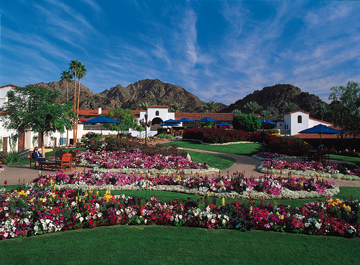
Hotels and resorts also have a feel to them. I was fortunate to recently       experience La Quinta Resort & Club in La Quinta, CA, 20 miles east of  Palm Springs. As I was walking to dinner at Morgan’s in the Desert (La Quinta’s signature restaurant), I stopped to take in the beautifully manicured grounds and the majestic scenery, which included the stunning shadows and colors of a sunset on the nearby Santa Rosa Mountains. La Quinta is a special place and it simply does not get much better than this historic resort. Many, many factors go into the allure of this property, but in the hospitality business it eventually all comes down to the staff. At La Quinta Resort & Club the service is superb.

The meal at Morgan’s was excellent. Chef de Cuisine Brian Recor and sommelier Francois Cinq-Mars have done an excellent job at this elegant Jimmy Schmidt restaurant. I will certainly have to return for a more thorough exploration of the entire facility; it obviously deserves the attention. This 45-acre resort, opened in 1926, is part of the Waldorf Astoria Collection and is comprised of 796 guest casitas, suites and villas, five championship golf courses, a 23,000-square-foot spa, and 23 tennis courts. (800) 598-3828 www.laquintaresort.com

Martin Ray: California Wine Legend

•January 17, 2010 • 2 Comments

When one thinks of some of the giants of the California wine industry, names like Mondavi, Gallo and Jackson certainly come to mind. Many others have made important contributions to the success of our state’s and country’s wine prominence, but one of the most important early pioneers was Martin Ray. I was reminded of this today when I read “The Legacy of a Wine Maverick” by Matt Kramer in this weekend’s edition of The Wall Street Journal. Kramer outlined Ray’s determination in the 1940s to plant Chardonnay, Pinot Noir and Cabernet Sauvignon high above Saratoga in the Santa Cruz Mountains. The vineyards and winery, Mount Eden Vineyards, remain today and Kramer discussed the wines of the current proprietors, Jeffrey and Ellie Patterson. I actually visited their property several years ago when I was fortunate enough to be selling their wines. It is a beautiful one-of-a-kind estate and the wines are incredible. I left the winery that day with an excellent book called “Vineyards in the Sky, The Life of Legendary Vintner Martin Ray,” by Eleanor Ray (Martin’s widow) with Barbara Marinacci. It is a well-written biography of Ray and also an interesting chronicle of the California wine industry. Kramer didn’t mention it in his article, but I learned from the book that in 1939 Martin Ray was the first person in this country to produce and market 100% varietal wines. His efforts also commanded prices of four times that of other California wines. The book is a great read and is still available at www.amazon.com. Martin Ray Winery also exists in Sonoma’s Russian River Valley. The founders there actually acquired the Martin Ray brand from his family and dedicated themselves to producing wines that would make Martin Ray himself proud. That winery’s history and mission are also worth reading at www.martinray-winery.com.

Chateau Musar – Remarkable Wine and History

•January 9, 2010 • 1 Comment

A few years ago, I was lounging at the pool at Caesar’s Palace in Las Vegas reading “A Big Sip of Vegas Reality” in the Food Section of the Los Angeles Times. The article outlined a trend of Los Angeles sommeliers moving to Las Vegas to advance their careers, and it chronicled the progression of Darren Lutz, who ended up at Joël Robuchon at MGM Grand. I knew Darren from our wine days in Los Angeles (some of you may remember him from Bastide), and I didn’t know he had moved to Las Vegas. I already had plans for dinner, but I decided to wander over to Joël Robuchon for a surprise visit and a glass of wine. It was a wise decision; I discovered one of the most remarkable white wines I have ever tasted.

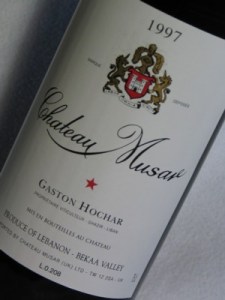
I had never been to a Joël Robuchon restaurant and this particular one is the only MICHELIN Guide three-star restaurant in Las Vegas. It is an elegant 60-seat gem with a small bar/lounge, where I sat down to say hello to Darren. He asked if there was something special I would like to try, and I said I was in the mood for an aged white Hermitage or something similar. He didn’t have an open bottle of white Hermitage, but he confidently revealed he had something that was as good, and perhaps better. He didn’t tell me its origin when he poured it, but what he served me was at that time, and quite possibly still is, one of the most sublime glasses of white wine I have ever experienced. The texture, complexity, layers of flavors, balance and finish were incredible. I couldn’t quite figure out its composition; in some ways, it reminded me of aged white Burgundy (chardonnay) and white Hermitage (roussanne/marsanne). It didn’t matter. I was sitting in one of the most famous restaurants in the world enjoying a beautifully complex wine, and at the same time had the opportunity to say hello to a friend in the wine business. Darren encouraged me to enjoy the wine while he looked after some patrons in the dining room. Eventually he returned to reveal that I was drinking a 14-year-old Chateau Musar Blanc from Lebanon’s Bekaa Valley, a blend of the indigenous grapes, obeideh and merwah (thought to be ancestors of semillion and chardonnay, respectively). Although I have studied the wines of Lebanon, and their reputation is well-known in the wine industry, it was amazingly my first taste of a Lebanese wine.

If you haven’t experienced the relatively inexpensive wines of Chateau Musar, I enthusiastically encourage you to do so. The Bordeaux-influenced reds, are from cabernet sauvignon, carignan and cinsault. Both whites and reds are aged for several years in barrel and bottle at the winery before release, so do not be surprised by the vintage of the bottles you find at a retailer or restaurant—they may be the current releases! They also produce a rosé and a second label called Cuvée Musar. The wines are readily available in the U.S., so if you do not find them in your wine shop, just ask your retailer to order some. The importer is Broadbent Selections. In my local area, I have enjoyed Chateau Musar Blanc at Palate Food & Wine in Glendale, CA. They have the 2000 vintage on their list for $53!

It’s no mystery that wine of such quality comes from Lebanon; after all, wine has been produced there for over 5,000 years and the Roman Temple of Bacchus (the Roman god of wine) is located in the Bekaa Valley. Several other wineries are producing good wine in Lebanon, but Musar has certainly garnered the reputation as the best.  www.chateaumusar.com

(Darren Lutz has since left Joël Robuchon and is now Manager of Wine and Spirits at the Nemacolin Woodlands Resort in Farmville, Pennsylvania and Chef Sommelier for their restaurant, Lautrec. Also, I was amazed to find a variety of spellings of obeideh and merwah; I took mine directly from Chateau Musar’s website.)

Favorite Wine Anecdotes: “Hot Dog in the Ballpark Syndrome”

•November 8, 2009 • Leave a Comment

Sorry, I’m not going to suggest the ultimate wine pairing for hot dogs; plenty of others have ably covered the topic, and I am not really a big fan of hot dogs. Instead, I want to discuss ”Hot Dog in the Ballpark Syndrome,” HDBS for short. You have certainly experienced this phenomenon; you just didn’t know it had a name. I intend to relate it to the enjoyment of wine, but it applies to many things, including fine art, food, and even relationships. I’ll elaborate on the others, but let’s begin with a discussion about wine and HDBS.

I was at a winery in Napa Valley many years ago and was fortunate to enjoy a private tour and tasting with the winemaker. We walked through the vineyards and production facilities on a beautiful summer day, and after tasting some samples from barrel, ended up in the private dining room to experience the current vintage and some library selections. I was blown away by the quality of the wines. I thought they were near perfect and I couldn’t imagine a better collection from Napa Valley or anywhere else. After returning home, I naturally sought out the same wines, and wanted my family and friends to enjoy the same experience I had in Napa. Although the wines still showed very well, I was stunned to experience something much short of the sensation at the winery. I was suffering from a bad case of HDBS. At home, I obviously didn’t have the passion of the winemaker, the beauty of the vineyards and the romance of the winery, to influence my experience.

If you haven’t already figured it out, I will elaborate on the origins of this syndrome. For various reasons some people, including me, will rarely eat a hot dog. However, many of us, again including me, will still order and invariably enjoy a hot dog at a baseball game. Why the gosh darn heck does it taste so good at a baseball game? Hot dog and bun producers will argue that the product is different, and of higher quality, at the ballpark. To me, it’s something else: you’re sitting in a beautiful, relaxed setting, engrossed in a classic American tradition of baseball, beer, peanuts AND hot dog consumption, and thousands of other people are doing exactly the  same thing. It’s what people do at the ballpark and it is a great experience when you’re there, and even better if you team is winning. Do we go home and suddenly become connoisseurs of hot dogs? No, but we are frequently emboldened to try one at the next backyard barbecue, and inevitably remember why we rarely eat hot dogs. They never taste the same.

Our environment obviously has a huge impact on our senses and judgement. Remember the wonderful date you had at that romantic restaurant overlooking the ocean, and then for some reason the second encounter at the bowling alley ended up being a disaster? Don’t blame yourself; it was HDBS. How about the beautiful, expensive painting you purchased at that charming gallery when the artist himself handed you a glass of chardonnay, draped his arm over your shoulder and passionately explained his inspiration for that particular piece? Every time you pass the painting, perched in its place of honor above the fireplace, you are haunted by the purchase. HDBS strikes again!

As far as wine is concerned, HDBS has its biggest impact when one is traveling abroad. When you’re sitting in a Venice cafe drinking a glass of the Veneto’s finest, it’s hard not to return to the States and shout from the mountaintops that Amarone, Soave, and Valpolicella are absolutely the best wines in the world!

Finally, another version of HDBS exists that is exacerbated by over consumption of wine. We have all attended a dinner party where the food was excellent, the conversation was lively, the guests were charming and, after several glasses, the wine became the finest ever poured. Paradoxically, the hangover the next day usually cures any lingering HDBS.

So is a hangover the ultimate antidote for HDBS as it relates to wine, or anything else for that matter? I do not necessarily recommend it. I simply contend that awareness of its existence is the first step to overcoming its embarrassing, and sometimes expensive, pitfalls. “Hot Dog in the Ballpark Syndrome” is real, it has consequences, and now it has a name.

Eisch — Breathable Glassware for Wine?

•October 11, 2009 • Leave a Comment

If you haven’t heard about Eisch Glaskultur, the wine glassware that has a unique “breathable quality,” I encourage you to check it out. Eisch applies a special “oxygenizing” treatment at the end of the manufacturing process that opens the nose of wine and softens the hard edges, particularly tannin and acidity. Amazingly, all of this happens within a few minutes after pouring, and can potentially have the same effect as an hour or two in a decanter. I know it sounds a little far fetched, but I have conducted numerous taste tests against comparable wine glasses and have experienced consistent results. I recently was involved in a tasting with both reds and whites and Eisch excelled again.

Eisch produces a wide line of glassware and decanters, but the three “breathable” wine glass lines regularly sold in the U.S. are Superior, Vino Nobile, and Vintec. I use the Vino Nobile and Vintec at home, and regularly put them in the dishwasher without any problems.

Admittedly (and amazingly), Eisch still sometimes does not show up on the radar of some wine industry veterans. Dorothy Gaiter and John Brecher reviewed wine glasses in their Wall Street Journal column yesterday, “Glasses, the Background Music of Wine,” and Eisch did not even garner a mention, even though they analyzed 25 different glasses. I’m not sure how their “broad search” could generate an article—which I thought was good in all other aspects—that did not include some sort of a nod to Eisch.

Ronn Wiegand (www.restaurantwine.com/), Master of Wine and Master Sommelier, has conducted extensive tests and has noted that Eisch enhances the taste of a wide variety of wines. Recommendations do not come with much higher authority than that. I would encourage you, however, to conduct your own taste test and/or ask for an opinion from your favorite wine shop or restaurant. Even if you do not buy into the “breathable” aspect, the glasses are beautifully made and durable enough for even restaurant use. (www.eisch.de)

(Disclosure: The wine distributor I work for also sells Eisch Glaskultur. I write about food, wine, hotels and ancillary products that I sincerely enjoy and use. Inevitably I will, from time to time, have some sort of connection to the subject matter of my posts. I would like to think that this does not disqualify me from writing about subjects I appreciate. When the associations are substantial, such as Eisch, I will disclose them. I welcome your comments.)

Favorite Wine Anecdotes–Are YOU “Special Bottle” Worthy?

•October 4, 2009 • 1 Comment

I have decided to stray, from time to time, from my usual drivel of reviews and commentary about food, wine and hotels, and share what I call “Favorite Wine Anecdotes.” These posts will chronicle some of my more amusing, curious, and sometimes embarrassing, personal experiences with wine over the years. I’m sure some of you have had similar encounters; they tend to repeat themselves in the world of vino. I hope you find these stories entertaining and perhaps educational. They will all be true, but the names will occasionally have to be changed (or avoided altogether) to protect the unsuspecting and innocent. So here we go.

Several years ago I was seeing a woman who loved food and wine. We were obviously a good match. She taught me a lot about cooking and I enthusiastically shared my wine knowledge. One evening we were in her kitchen enjoying a glass of wine while she prepared some hors d’oeuvres. I was asked to grab an ingredient out of the refrigerator and I happily discovered a bottle of Champagne resting on one of the shelves. I commented that it was a great bottle and an excellent vintage. She revealed that someone from work had given it to her, and she was saving this “Special Bottle” for the appropriate occasion. I said something like, “oh, that’s nice” and thought to myself that I had a very good chance of sharing it with her sometime in the future. Every time I visited her home for dinner or to pick her up for a date, I anxiously anticipated the pop of that special cork. The relationship had progressed in almost all other aspects (insert imagination here), but for some reason I was never able to rise to the level of being “Special Bottle” worthy. Eventually, I became vexed about that bottle of Champagne, and we stopped seeing each other for one reason or another. Unfortunately, I had never felt comfortable enough to broach the “Special Bottle” mystery with her (or our common friends). I still do not know if anyone was ever lucky enough to share that bottle with her or whether it remains perched up there in the refrigerator, waiting for the right guy.

In retrospect, I can honestly say that I never took it personally. OK, I took it personally. We all save thatSpecial Bottle” for a unique moment, occasion and/or person, and oftentimes never pull the cork until it’s too late. Eventually, all of us end up on both sides of the “Special Bottle” equation. I have done it, you have done it, SHE DID IT, and unfortunately, it will continue to perplex wine lovers around the world. So, what do you think? Are YOU “Special Bottle” worthy?